
Reviewed · HISTORICAL TOURS
Doha: North of Qatar Tour, History and heritage
Qatar’s quiet north tells a different story. This four-hour trip from Doha takes you to Al Khor’s old pearling harbor, the mangroves of Purple Island, UNESCO-listed Al Zubara Fort, and an unusual desert art installation. I like the mix of coastal nature and traditional culture, and I like having private, air-conditioned transport for a long outing beyond the capital. The main drawback is that the route covers a lot of ground, so each stop gets only a short visit.
The tour costs $59 per person and allows a maximum of six people. That makes it a good value for a small group that wants a guide, hotel pickup, bottled water, and tea or coffee without arranging a rental car. Guide quality can shape the day, so it is worth requesting a strong guide if possible. Tariq and Usman, also written as Usmaan, receive especially warm praise for clear explanations, friendly service, and flexibility.
In This Review
- Five good reasons to consider this northern Qatar outing
- Why the north is worth your half-day
- Al Khor: Qatar’s old pearl and fishing harbor
- Purple Island: mangroves, quiet paths, and open air
- Al Zubara Fort: Qatar’s best history lesson outside Doha
- The desert artwork at 2394+R3
- The guide can make or break the day
- Comfort, timing, and what the $59 covers
- Who should book this tour?
- Final call: a strong way to see Qatar beyond Doha
- FAQ
- How long does the North of Qatar tour last?
- What is the tour price?
- How many people can join the tour?
- Is pickup available?
- What transportation is provided?
- Are drinks included?
- Is the Al Zubara Fort admission fee included?
- Can I cancel for a full refund?
Five good reasons to consider this northern Qatar outing
- Al Khor’s old pearling center: See the harbor town that once played a major role in Qatar’s pearl and fishing economy.
- Purple Island mangroves: Walk beside quiet coastal vegetation and enjoy a calmer setting away from Doha.
- Al Zubara Fort and UNESCO site: Visit Qatar’s first UNESCO World Heritage Site and learn about a former port and trading center.
- Private transport for up to six people: An air-conditioned vehicle makes the long northern route much easier than piecing it together alone.
- A striking desert art installation: See twenty circular shelters arranged around a fivefold pattern in the open desert.
Why the north is worth your half-day
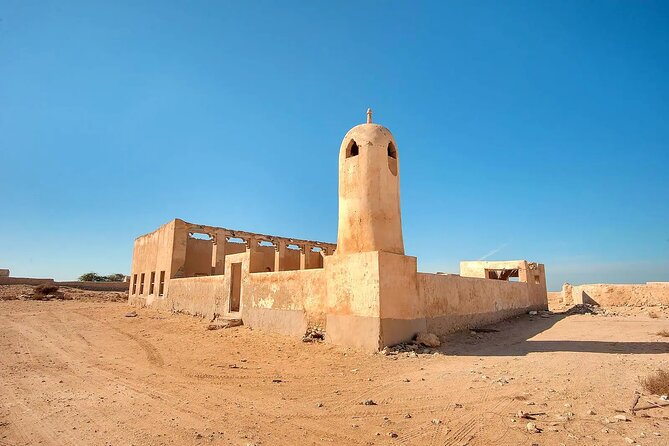
Doha gives you museums, towers, souqs, and polished waterfronts. Northern Qatar offers something less finished and more revealing: old ports, ruined settlements, mangrove channels, fishing traditions, and wide stretches of desert. You see the country as a place shaped by the sea as much as by oil and modern construction.
This matters because Qatar’s past can be easy to miss. Many visitors stay near central Doha, where the country’s older ways of life are presented inside museums. Here, you travel to the places where pearl fishing, boat building, trade, and coastal settlement actually took place.
The route is also practical for a short stay. At roughly four hours, it fits into a morning or afternoon rather than taking a full day. Pickup is offered, and the vehicle is private to your group, with no more than six people. You are not left trying to navigate distant sites in the heat or work out the route between stops.
The pace is brisk. Al Khor and Purple Island each receive about 45 minutes, Al Zubara Fort gets around an hour, and the art installation takes about 40 minutes. If you like a broad introduction, this works well. If you prefer long walks, extended museum time, or careful photography at every stop, you may want a slower private day.
More history on the ground:
- Full Day Qatar’s North And West tour || History & Heritage
★ 5.0 · 229 reviews - Desert Safari + History to Modern City Tour
★ 5.0 · 174 reviews - From Doha: Culture & History Qatar Tour to the North & West
★ 5.0 · 51 reviews
Al Khor: Qatar’s old pearl and fishing harbor
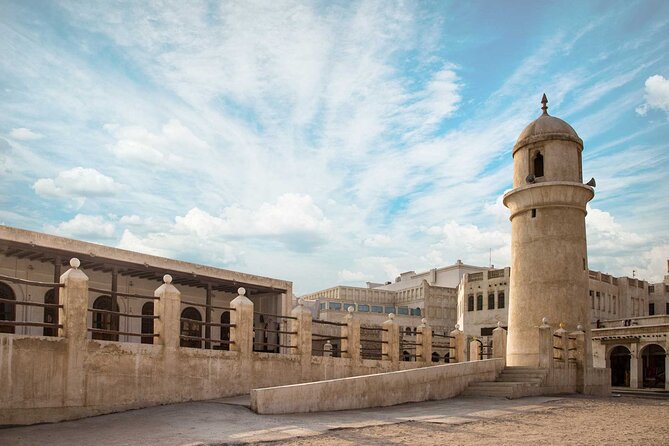
Your first major stop is Al Khor, about 50 kilometers north of Doha. The Arabic name means sea on three sides, a fitting description for a town shaped by its position along the coast.
Al Khor is older than Doha, though much smaller. Before cultured pearls changed the industry, this was one of Qatar’s main centers for pearl fishing. Local workers also built and used traditional dhows, the wooden boats that carried people, fish, and goods along the Gulf.
The harbor is the focus of the visit. You can see traditional fishing dhows, walk along the corniche, and look toward nearby mangrove colonies. The town’s museum adds context by presenting the fishing, pearl, and dhow-building trades that supported life here.
I would pay attention to the contrast between the harbor and Doha. In the capital, Qatar’s modern wealth is hard to miss. In Al Khor, the older economy is easier to picture: boats close to shore, families tied to the sea, and a town whose fortunes depended on natural resources long before modern energy wealth.
The 45-minute stop is enough for a look around, but not a full study of the town. Admission is listed as free. Bring a hat and water even though bottled water is supplied, since you may spend part of the visit outside.
Purple Island: mangroves, quiet paths, and open air
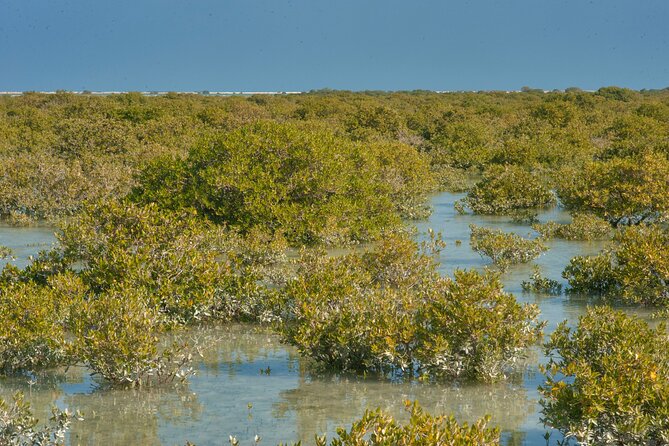
The next stop is Purple Island, also called Al Khor Island. It is a peaceful coastal area with mangroves and greenery, giving the tour a welcome change of pace after the harbor.
The name may suggest bright colors, but the real appeal is the setting. You get a chance to walk, take photographs, and look across a natural area rather than another city street or historic building. The mangroves create a different kind of Qatar experience, one shaped by shallow coastal water and plant life.
The visit lasts about 45 minutes and admission is free. The supplied description also notes walking, family picnics, and kayaking options, though this four-hour tour does not promise a kayaking session. Treat the stop primarily as a short nature walk and photo break.
This is one of the places where comfortable shoes help. The tour data does not specify the exact walking surface, so you should not expect a long paved promenade everywhere. In hot weather, the shade may be limited. Still, the stop gives you a useful view of Qatar beyond desert and architecture.
I like this part of the route because it keeps the tour from becoming a string of forts and ruins. You see how coastal habitats fit into the northern part of the country, and you get a quieter pause before the main historical stop.
Al Zubara Fort: Qatar’s best history lesson outside Doha
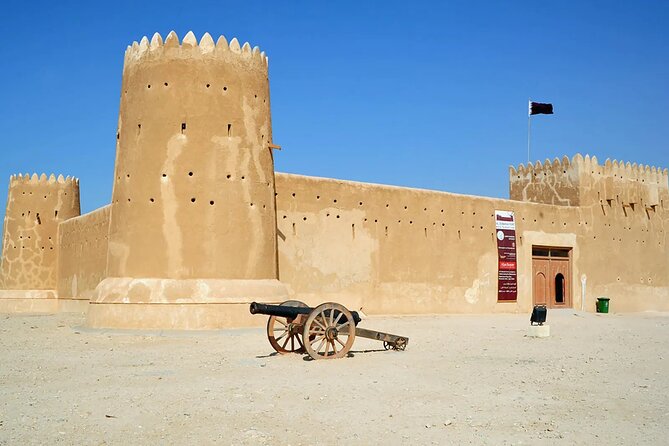
Al Zubara Fort is the centerpiece of the excursion. Located in northwestern Qatar, the fort was built beside the remains of an older fort and is connected to the ruins of Al Zubarah, once a prosperous port for trade, fishing, and pearl fishing.
The wider Al Zubarah archaeological area is Qatar’s first UNESCO World Heritage Site. That designation is important, but the real value lies in what the place helps you understand. This was once a working settlement with commercial links across the Gulf. Today, much of it has been reclaimed by sand and time.
The renovated fort displays artifacts found through archaeological work led by the Qatar Museums Authority and international specialists. Your guide can help connect those objects to the wider story of the former port. Guides such as Tariq and Usman have been praised for explaining each site before arrival and answering questions along the way, which is particularly useful here.
Allow about an hour. The entrance fee is not included in the $59 price, and all fees and taxes are listed separately, so check the current admission cost before booking. The supplied information does not give a fixed amount for entry.
There is a useful distinction between the fort and the archaeological site. The fort gives you a defined building to enter and photograph. The surrounding ruins require more imagination. You may see traces of a settlement rather than intact streets and grand monuments. That is part of the appeal, but it can disappoint anyone expecting a fully preserved old town.
This stop is strongest when you listen to the historical explanation. Without context, a fort and scattered remains can seem spare. With context, the site becomes a record of a coastal economy that thrived before modern Qatar took shape.
A completely different sort of day out from Doha:
- Doha: Safari, ATV, Camels, Sandboarding and Inland Sea Tour
★ 4.8 · 5,291 reviews - Doha: ATV, Quad/Buggy Dune Bashing, Camel Ride, Sandboarding
★ 5.0 · 3,784 reviews - Desert safari, Dune bashing, sandboarding, camel, ATV Option
★ 5.0 · 2,826 reviews - Qatar Gold Dune Safari, Dune Bashing,Camel Ride,Sand Boarding,Inland Sea Desert
★ 5.0 · 2,807 reviews
The desert artwork at 2394+R3
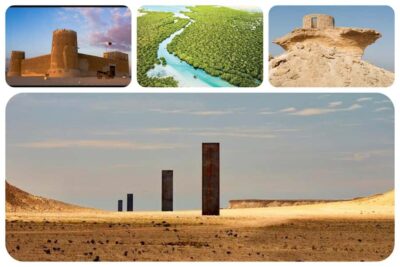
The final listed stop is an unusual piece of site-specific art identified by the map reference 2394+R3. Twenty circular shelters, three single rings, and two double rings are arranged across the desert.
The pattern is not random. The central ten shelters form a pentagram, while the full arrangement follows the axes of a fivefold symmetrical design. The work draws attention to mathematical patterns that may also have influenced sophisticated designs in Islamic cultures during the medieval period.
You get about 40 minutes here, with no admission fee. This is not a conventional historic monument, and your enjoyment will depend on whether you like abstract art and geometric ideas. The open setting gives you a strong sense of scale, but there may be little shade or shelter from the weather.
I see this as a fitting final stop. After learning about old fishing towns, mangroves, and a vanished port, you encounter a modern work that asks you to look at Qatar’s desert in a different way. It also gives the guide a chance to explain how mathematics, architecture, and visual design can overlap.
The exact site name may be less familiar than the fort or island, so save the map reference when you book. It can help you recognize the stop if you are checking the route in advance.
The guide can make or break the day
The strongest part of this experience is not only the route. It is the person explaining it.
Tariq receives particularly strong praise for his historical explanations, friendly manner, help with photographs, and attention to small comforts. He has also been described as offering tea, cold water, and guidance on the best photo spots. Usman, or Usmaan, is praised for being punctual, well informed, respectful, and flexible about stops and drop-off arrangements. Other guides named in feedback include Zia, Wadood, and Adil.
Adil is noted for taking especially good photographs. Zia is praised for organizing pickup and adapting pickup and drop-off points. Wadood is described as a good guide for explaining local history and culture.
The experience is not identical with every guide. One less favorable account describes a guide who gave little explanation, leaving the group to work out the meaning of several places alone. That is a fair warning. The sites are spread out, and the long drives are much more rewarding when the guide uses them to explain Qatar’s past.
If you can communicate a preference when booking, ask for a guide who is comfortable discussing history and culture. That simple request may matter more here than it would on a short city transfer.
Comfort, timing, and what the $59 covers
The $59 per-person price includes private transportation in an air-conditioned vehicle, bottled water, and coffee or tea. Pickup is offered, and the vehicle can carry a maximum of six people. For a small family or group of friends, that is a useful arrangement because you avoid public transport connections and do not need to manage the long drive north.
The value is strongest for groups of two to six. Solo visitors may still appreciate the convenience, but the per-person price feels better when shared among a small party. The tour also makes sense during a short Doha stay, when you want to see more of Qatar without committing to a full-day excursion.
The listed duration is about four hours, though the pace can vary. Some outings may run longer when the guide spends more time answering questions or adjusting the route. Do not schedule a tight appointment immediately afterward.
Tea and water are more than small extras in Qatar’s heat. The drinks make the drive more comfortable, and several guides have been praised for keeping refreshments available. Still, there is no meal included, so plan food separately if you need it.
Admission to Al Zubara Fort is not included. The general terms also exclude fees and taxes. Confirm the final total and any entrance charge before you commit.
Who should book this tour?
I would recommend this trip to you if you want history, coastal scenery, and a look at Qatar beyond Doha in one compact outing. It suits first-time visitors, families, small groups, and anyone who prefers a guide rather than a self-drive route.
It is also a good choice if you care about local context. Al Khor shows the old pearl and fishing economy. Purple Island adds a nature stop. Al Zubara explains Qatar’s place in Gulf trade. The desert artwork brings in a modern cultural angle.
You may want something else if you need a slow, unhurried day. The four main stops are spread across northern Qatar, and the time at each place is limited. The tour is also less suitable for someone seeking a dedicated outdoor adventure, since the walking and kayaking possibilities at Purple Island are not presented as the main activity.
The 98 percent recommendation rate and 4.9 rating from 40 recorded ratings point to a very strong overall experience, but the guide variation is worth keeping in mind. The best accounts praise Tariq and Usman for turning the drive into part of the lesson. A quiet or less engaged guide would make the same route feel much thinner.
Final call: a strong way to see Qatar beyond Doha
Book it if you want a manageable introduction to northern Qatar, especially with a small group and a guide such as Tariq or Usman. The combination of private transport, four distinctive stops, refreshments, and a modest price gives you good value.
You will not see every northern site, and you should not expect long, leisurely visits. But you will come away with a clearer sense of how Qatar grew from coastal communities built around pearl fishing, boats, trade, and desert settlements. For many visitors, that is the most useful story the capital cannot tell on its own.
Free cancellation is available up to 24 hours before the start time for a full refund. Changes or cancellations within 24 hours are not accepted for a refund.
FAQ
How long does the North of Qatar tour last?
The tour lasts approximately four hours.
What is the tour price?
The listed price is $59 per person.
How many people can join the tour?
The tour has a maximum of six participants.
Is pickup available?
Yes, pickup is offered.
What transportation is provided?
The tour includes private transportation in an air-conditioned vehicle.
Are drinks included?
Yes. Bottled water, coffee, and tea are included.
Is the Al Zubara Fort admission fee included?
No. Admission to Al Zubara Fort is not included, and all fees and taxes are listed separately.
Can I cancel for a full refund?
Yes. You can cancel at least 24 hours before the experience start time for a full refund. Cancellations within 24 hours are not refunded.
Just added around Doha
- Explore desert Qatar: Off-Road Adventures, dune bashing Tour★ 5.0 · 3 reviews
- Doha: Desert Buggy Ride, Camel Ride, Dune Bashing, Sandboard★ 5.0 · 3 reviews
- Private Wakesurfing or Wakeboarding along Doha’s skyline★ 5.0 · 3 reviews
- “Doha Desert Safari with all activities”★ 5.0 · 3 reviews
- Private Desert Safari, Sand Dunes Bashing and Inland Sea Visit★ 5.0 · 3 reviews
- Guided Doha Sightseen Tour By Certified Tour Guide (Private Tour)★ 5.0 · 3 reviews
- Grand Qatar Tour★ 5.0 · 3 reviews
- Doha: Private City tour from Cruise Port terminal★ 5.0 · 3 reviews
Historical Tours, compared.
Full Day Qatar’s North And West tour || History & Heritage
Read our review →
Doha Combo a Rich Heritage from the Desert to the City
Read our review →
Full day City and North Qatar tour | History and Heritage
Read our review →
Combo Culture & Adventure: North Qatar Heritage & Desert Safari
Read our review →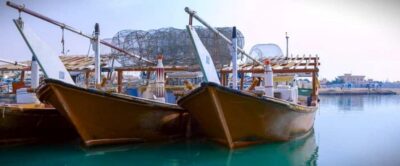
Explore Qatar’s Past: North & West Full-Day Heritage Tour
Read our review →
Full- day Qatar North And West Tour | History And Heritage
Read our review →Browse the lists this tour appears in